Handing Content Production Over to AI in the Name of Search Does More Harm Than Good
You aren’t likely to find a marketer these days who isn’t feeling challenged by the impact of AI on search traffic.
Some marketers, unfortunately, practice content abuse – also defined by the onomatopoeic term “AI slop” – which is the production of low-quality, high-volume, AI-generated digital content designed to manipulate algorithms for higher visibility and to win clicks.
However, the real results are far different.
68% of Consumers Regularly Question Content Authenticity
Brands publishing AI slop risk damaging their reputations and consumer trust; in fact, a Gartner report found that 68% of consumers doubt the authenticity of brand content.
The Wall Street Journal identified several brands getting ahead of this growing skepticism by adopting “No AI” disclaimers and elevating real artists, writers, and photographers in their marketing.
The presence of AI slop in content can be somewhat easy to spot; Fast Company recently described it as a “flat, awkward feel”, pointing out that brands eager to adopt automation may benefit from producing content faster and more efficiently, but risk losing the personality and authenticity that makes it credible to consumers.
However, the risks go beyond harming your brand’s personality or authenticity. AI is now acting as your brand’s gatekeeper, and producing AI slop has far greater implications for propagating inaccuracies and aligning your brand with misinformation.
This article explores how to compete in the AI search landscape without becoming party to the proliferation of AI slop.
Is Anyone Talking About AI Content Pipelines?
Many organizations have decided to use AI to create a content pipeline, in which AI can research, create, edit, optimize, and distribute content with little human involvement.
I have come across some mentions of AI content pipelines in my research, but there is no authoritative commentary about them, particularly about any implications. Leading search results come from the AI content pipeline tools themselves, and unsurprisingly champion the benefits of handing over the manual, time-intensive work of producing content to agentic AI systems.
In an ebook, Jasper, an AI marketing platform, defines AI content pipelines this way:
“These pipelines generate high-quality, on-brand content at scale, with human marketers guiding strategy and ensuring brand authenticity. Instead of bottlenecking production, teams now orchestrate it.”
On its face, a content pipeline sounds like a helpful system. And it makes sense as a strategy for marketers trying to reverse the search damage of traffic lost to AI overviews.
But what happens if the AI is pushing incorrect or false content into the pipeline?
Risking Accuracy in the Name of SEO
Lily Ray, Founder of Algorythmic, stumbled across a major blip in retrieval-augmented generation (RAG) systems like Perplexity and AI overviews perpetrated by AI content pipelines.
Upon asking Perplexity for the latest news on SEO and search, it populated news about an algorithm update Google had just rolled out that…didn’t exist. Sure enough, the cited sources were AI-generated blogs on SEO agency websites.
Ray termed this fake news phenomenon the “AI sloop loop” and goes on to explain that it’s actually an all-too-common pattern stemming from AI hallucinations.
I asked ChatGPT to turn this pattern into a visual – largely to help convey the information, but also because I always find it amusing and ironic when AI is forced to be critical of itself.
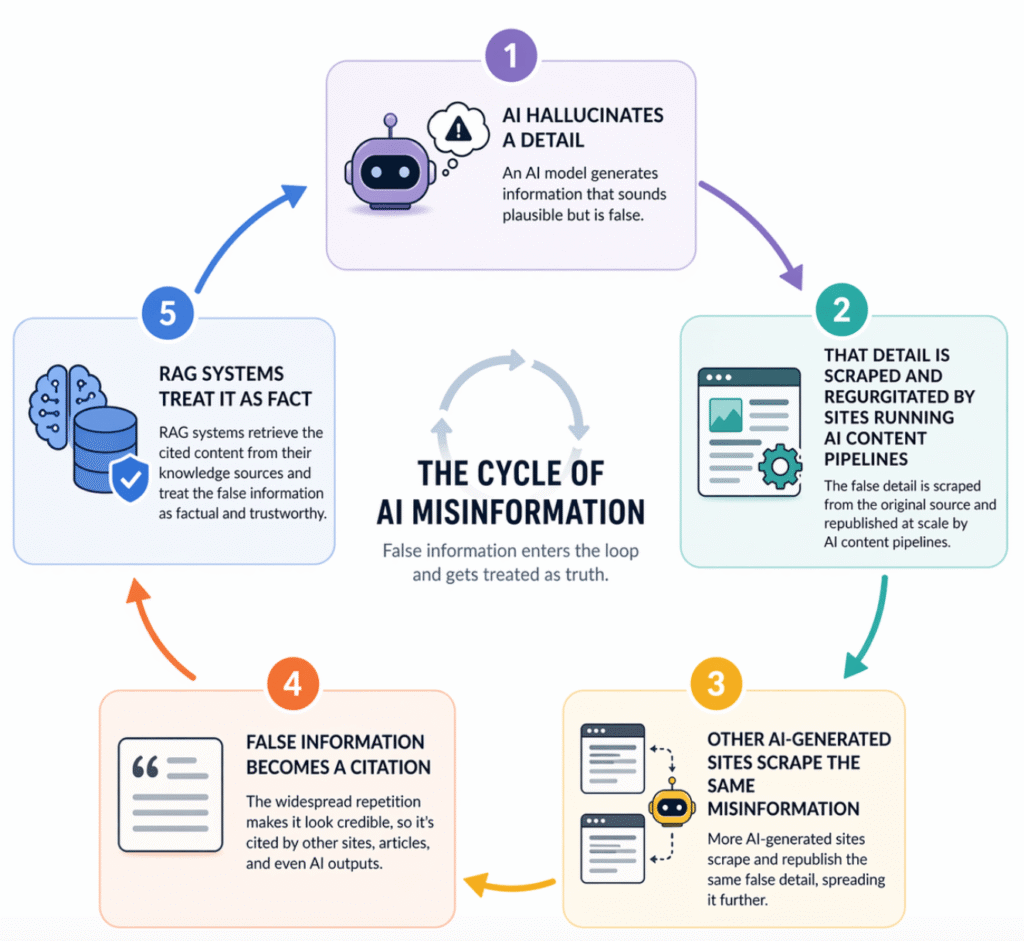
Clearly, if the AI is putting bad information into the pipeline, it’s doing nothing more than propagating the AI slop loop while making everyone feel like it’s working well.
Pedro Dias explains this pattern perfectly in a recent article featured by Search Engine Journal.
- Marketers turn to an AI content pipeline to improve AI search performance.
- The AI pipeline publishes incorrect or false information.
- Other content pipelines pick up that incorrect or false information and cite the original content as the source.
- That information gets picked up by other RAGs and eventually appears in AI overviews.
- The original marketers see the AI overview citation and believe the pipeline is driving success.
What is your citation and search result worth if the information that’s achieving it is bad?
Here’s a different angle.
For marketers struggling to claw back traffic by rethinking their content and SEO strategies to appease AI, rather than hand the reins to AI and risk plunging your brand into the AI slop loop, try combining AI search tactics with traditional SEO.
Balancing Generative Engine Optimization with Traditional SEO
The impact of LLMs on search traffic has forced marketers to upend their content strategies and shift focus to generative engine optimization. But SEO remains a critical strategy – it simply now must be combined with generative engine optimization-friendly tactics.
Here are our best recommendations for pivoting to a more balanced search strategy using generative engine optimization and SEO that won’t propagate the AI slop loop.
- Content Accessibility: Content engagement must be frictionless, but AI has heightened the long debate over whether to gate content or just give it away for free in the noble name of search rankings.
Search Engine Land takes a more measured stance: sometimes, gating content makes sense; most of the time, it’s not helpful. Gating is acceptable for deep research or thought leadership pieces, but only after your brand has earned trust and citations. Never gate any content that your audience or AI would use to understand, discover, or build credibility in your brand. Essentially, gated content hides valuable insights behind a PDF or a form – the literal opposite way to get content cited by AI.
Rule of Thumb: Gated or download-only content should be reserved for high-intent interactions in the middle or bottom of your sales funnel – not the top.
- Content Writing Structure: Along with traditional SEO tactics, AI search demands topic authority over keyword volume, coupled with clear, structured formatting and answer-first, conversational writing. Our recent article SEO Looks Different Now [link to the SEO article on FNM] explains how to successfully structure your content for both SEO and AI search.
Rule of Thumb: When publishing top-of-funnel content intended to drive discoverability and build credibility, follow a content structure that plays nice with AI search.
- Diverse Content Formats: Going hard on blogs to support your content strategy has been an outdated approach for some time, and now more than ever. Gartner’s (correct) 2025 forecast that traditional search traffic would decline by 25% in 2026 prompted recognition that content format is a critical area of focus in this rapid shift to AI search.
AI-friendly content includes:
- Videos
- FAQs
- Structured data tables
- Bulleted lists
- Virtual events
- Interviews
- Case studies
- Comparison tables
- Step-by-step guides
Rule of Thumb: Weave these high-performing content formats into your strategy regularly to ensure AI models can easily parse and cite your information.
- Algorithmic AI Relationships: Optimizing for clicks has shifted to optimizing for influence. Forbes has recognized a shift from traditional content marketing to “performance marketing”, explaining that the old keywords/backlinks/technical site health-based SEO playbook has been replaced with a playbook built on content relevance, authority, and quality. The more relevant or authoritative AI deems your content to be, the more it gets cited.
More impressions = more trust = better relationship with your AI algorithm.
Rule of Thumb: Whatever content you’re producing, make it the most qualified answer out there so AI will cite it, and searchers will have a reason to click.
“Human Involvement” is the Requirement for AI Use
AI is imperfect – I often feel like I have to remind people it’s not actually a human. AI doesn’t fact-check; it prioritizes fluency over truth.
You can use AI to spin up fluent content quickly, but if you eliminate the human oversight, it may not be truthful content – and that’s a bigger problem for your brand than struggling with search traffic.
If you want help balancing search traffic challenges with a content strategy your brand can stand behind, get in touch with the Fishnet team today to map out your next steps.